
Senior information architect / BOSTOCK&POLITT / COI 2006
GOVERNMENT INFORMATION
Context
DirectGov was the UK government’s central digital service platform, providing information on rights, entitlements and public services.
Bostock & Pollitt are a London design agency, who won this flagship Central Office of Information account by championing iterative design methodologies.
CHALLENGE
Users required clear, structured access to a wide range of government information services, from Driving License renewal to immigration processes.
Stakeholders ranged across departments with and without ministers, from DVLA to Border Force and HMRC, with relationships undergoing restructuring, overseen by the Home Office and the Central Office of Information, according to strict standards of information presentation, usability and accessibility.
My Role
Led information architecture discovery and refinement tasks across service categories
Collaborated with policy, editorial, GDS, departmental stakeholders and consultants
Conducted iterative testing and validation (card sorting, prototypes, goal finding)
Collaborated with designers and developers on design standards for site navigation, search, results, information presentation and editorial flows
Presented findings at departmental and ministerial reviews.
APPROACH
Extensive mixed methods research, including stakeholder interviews, ethnographic studies, and user journey mapping across a wide range of services, including driving, immigration, housing and benefits.
Helped transform the digital ecosystem from organisation-centric content models to user-centred, research-driven design, aligned with the IPSV taxonomy and stringent usability and accessibility standards.
Developed and presented Big Idea information architecture, including navigation, search, results filtering, process wizards.
Iterated detailed wireframes for key pages and user journey features and widgets.
Advocated for and installed UXR practices across a large, siloed civil service stakeholder environment
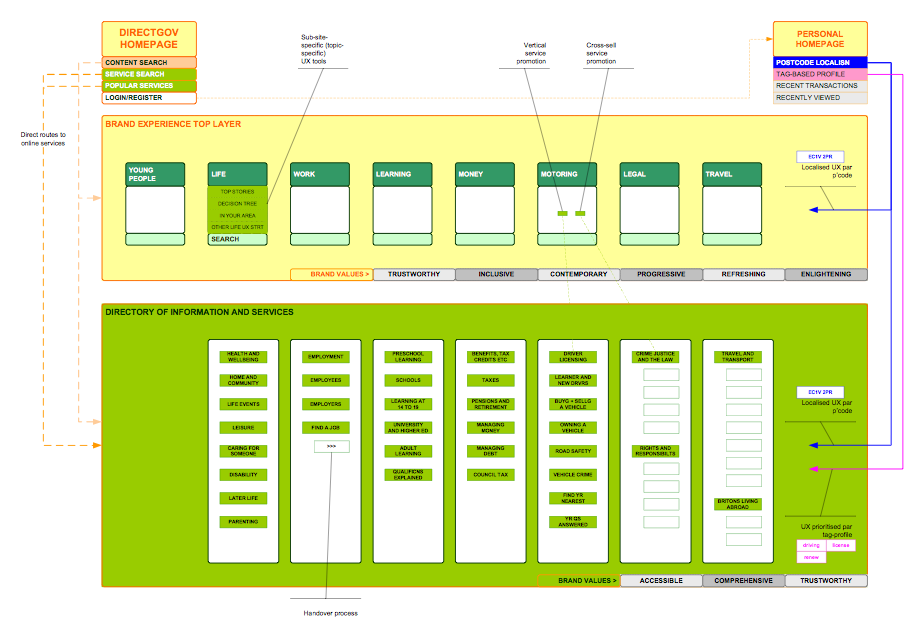
High level architecture, showing horizontal user journeys across vertical information siloes.
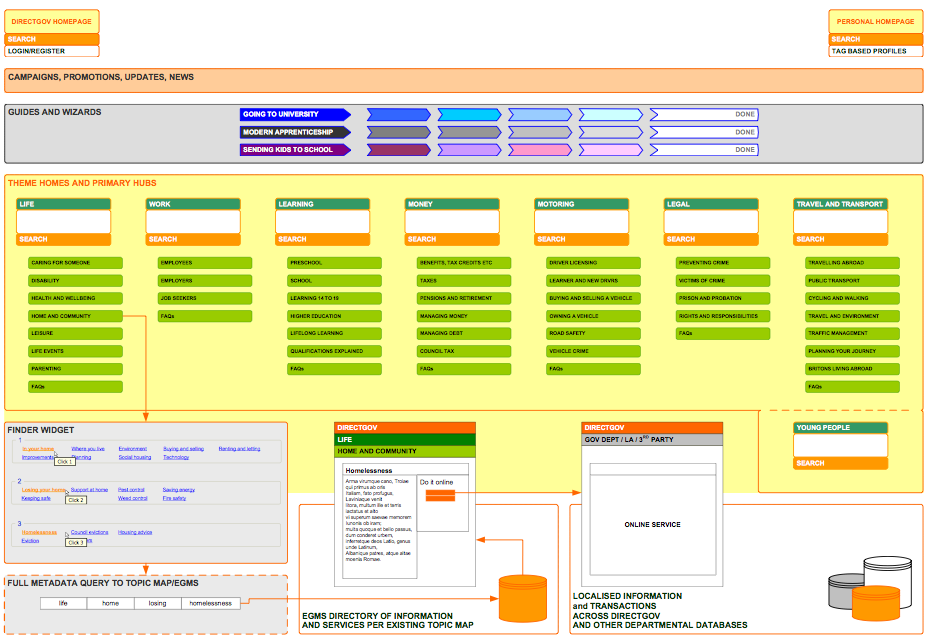
Developing info architecture to show layered service design
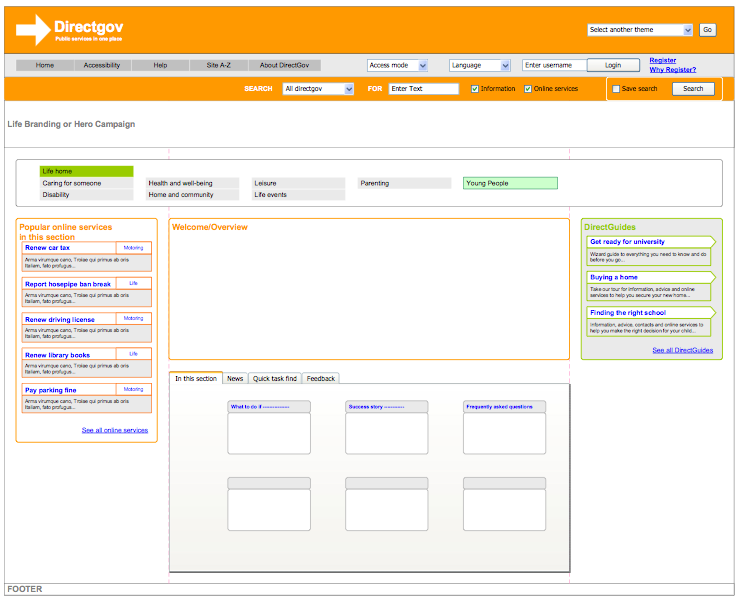
User homepage/dashboard wireframe
Outcome
Improved task-based navigation for high-traffic public service journeys
Built consistency and usability across structured service categories
Handed over IPSV—aligned high level architecture
Including blueprints for search, results filtering, article-level page layouts, process wizards and widgets.